The Story Behind A Moment of Confection
A MOMENT OF CONFECTION: The Secret Life of Parisian Meringues
Paris is a city of layers; some of them history, some of them limestone, and many of them whipped egg whites and sugar. We often think of French cuisine as a grand, public performance: the gleaming copper pots of a Michelin-starred kitchen or the artful display of a pâtisserie window. But there is another side to the sweetness, a more incognito world that exists just behind the frosted glass.
The Surrealism of the Half-Seen
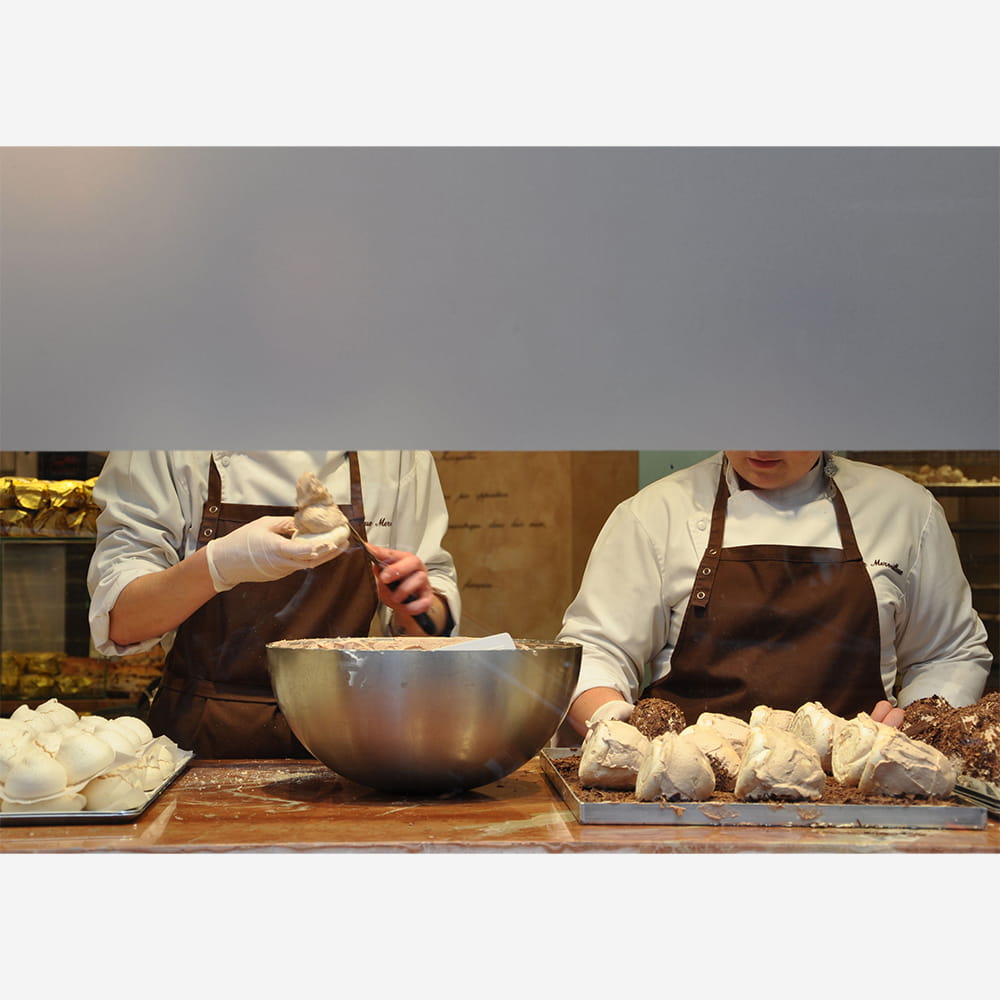
In this “found image,” we are granted a keyhole view into the clandestine theatre of the confection. The composition itself feels inherently surreal. By cutting off the faces of the artisans, the image strips away individual identity and replaces it with the rhythmic, mechanical grace of the craft. We see hands – gloved, precise, and ghostly – manipulating dollops of cream as if they were sculptural clay.
It’s a scene that feels less like a bakery and more like a laboratory of whimsy. Without the context of a full face, the workers become anonymous agents of a sugar-laden underground. This sense of secrecy adds a layer of mystery to the mundane; it suggests that the perfection of a Parisian meringue isn’t just a recipe, but a ritual performed in the shadows.
Anatomy of a Cloud
At the centre of the frame lies a large silver bowl, a vessel of potential. Surrounding it are the finished products:
The Whites: Pure, snowy mounds of air and sugar, waiting for their transformation.
The Ganache: Rich, textured peaks being carefully shaped by hand.
The Shavings: A bed of dark chocolate debris, ready to coat the delicate structures.
The meringue, or Le Merveilleux, is a staple of French culinary art. It is a study in contradictions: hard yet fragile, heavy in appearance yet light as breath. In this half-obscured kitchen, we see the physical labour required to create something that is meant to disappear instantly on the tongue.
Why Secrecy Flavours the Experience
There is something quintessentially Parisian about this voyeurism. The city thrives on the “hidden gem” and the “secret courtyard.” By viewing the pâtissiers through a narrow aperture, we are reminded that the best things in life are often tucked away, requiring us to lean in and look closer.
The incognito nature of the work elevates the pastry from a mere snack to a curated secret. When you finally bite into that crisp, airy shell, you aren’t just eating dessert; you are consuming the result of a silent, focused effort that happened just out of sight.
In a world that demands to see everything in high-definition and full-frame, there is a profound beauty in the unseen. These anonymous hands, the dusted marble counters, and the quiet clinking of a spatula against a bowl remind us that the magic of French cuisine lies in the mystery of the making.