The Story Behind Still Life: Market Stall
STILL LIFE: MARKET STALL – Tenerife, Canary Islands
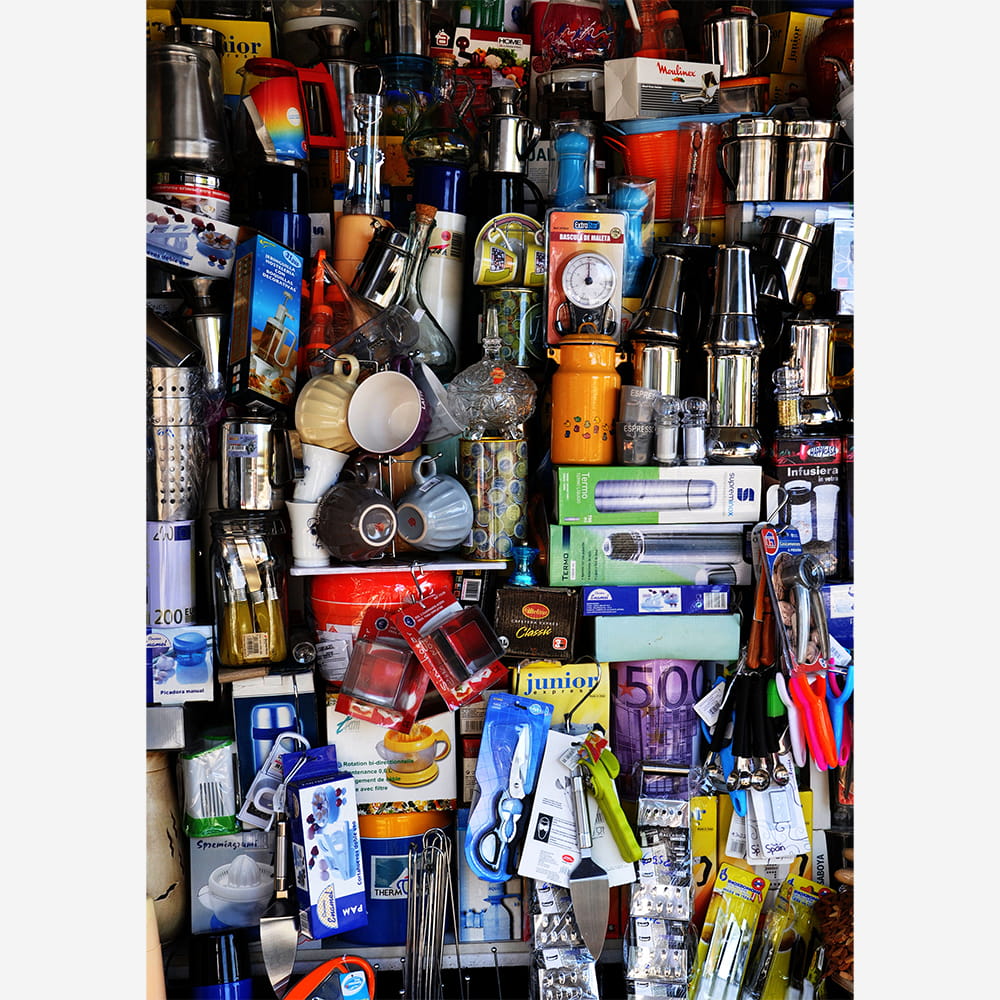
The alleyway was a narrow throat of shadows, smelling of damp stone and over-roasted coffee, until I rounded the corner and collided with the sun. It wasn’t the sky that blinded me, but a wall – a vertical landslide of chrome, ceramic, and primary colours that seemed to hum with a kinetic energy of its own.
This was no mere market stall; it was a cacophony of sight, a visual jazz session where every object played a frantic, clashing note.
The vendor, a man whose face was a map of deep-etched wrinkles and quiet patience, sat tucked into a sliver of negative space, barely visible behind his hoard. He didn’t hawk his wares. He simply presided over the chaos. My camera felt heavy in my hand, almost intrusive. How do you capture a riot?
A Symphony of Texture
My eyes struggled to find a tether. To the left, the dull, brushed steel of industrial thermoses stood like stoic guardians, their matte surfaces absorbing the light that their neighbours so greedily reflected. Beside them, the vitreous shine of ceramic mugs – ochre, slate, and bone-white – offered a smoother, domestic comfort.
Then came the plastic. A jarring, electric blue pair of kitchen shears hung suspended, their synthetic translucence screaming against the rustic backdrop. Nearby, a stack of boxes featured the weathered, grainy texture of cardboard that had lived through a dozen humid seasons, their corners softened by time and touch.
The Palette of the Everyman
The colour story was one of accidental brilliance. There was no curation here, only the organic accumulation of necessity.
Safety Orange: A funnel and a kettle provided pops of high-visibility warmth.
Chrome Silver: The polished carafes and espresso makers acted as curved mirrors, distorting the street behind me into miniature, silvery fish-eye worlds.
Canary Yellow: A pair of brightly printed cups, ready for the endless coffees they will deliver.
The most jarring note was the currency. Massive, oversized replicas of Euro notes; a purple 500, and a blue 20 were plastered into the gaps like wallpaper. They felt like a satirical commentary on the humble value of the objects surrounding them: a garlic press, a whisk, a simple glass bowl.
I raised the viewfinder, framing the centre of the madness. The “ExtraStar” luggage scale, with its round, inquisitive face, looked back at me like a cyclopean eye. In that moment, the stall felt less like a shop and more like an urban altar. It was a testament to the sheer “much-ness” of human life – our endless need for gadgets to measure, pour, cut, and contain.
As the shutter clicked, the vendor finally looked up. He didn’t smile, but he didn’t look away. He simply adjusted a hanging grater, the metal teeth catching the light with a lethal glint, and returned to his silent vigil over his kingdom of things.