The Story Behind The Last Step
THE LAST STEP
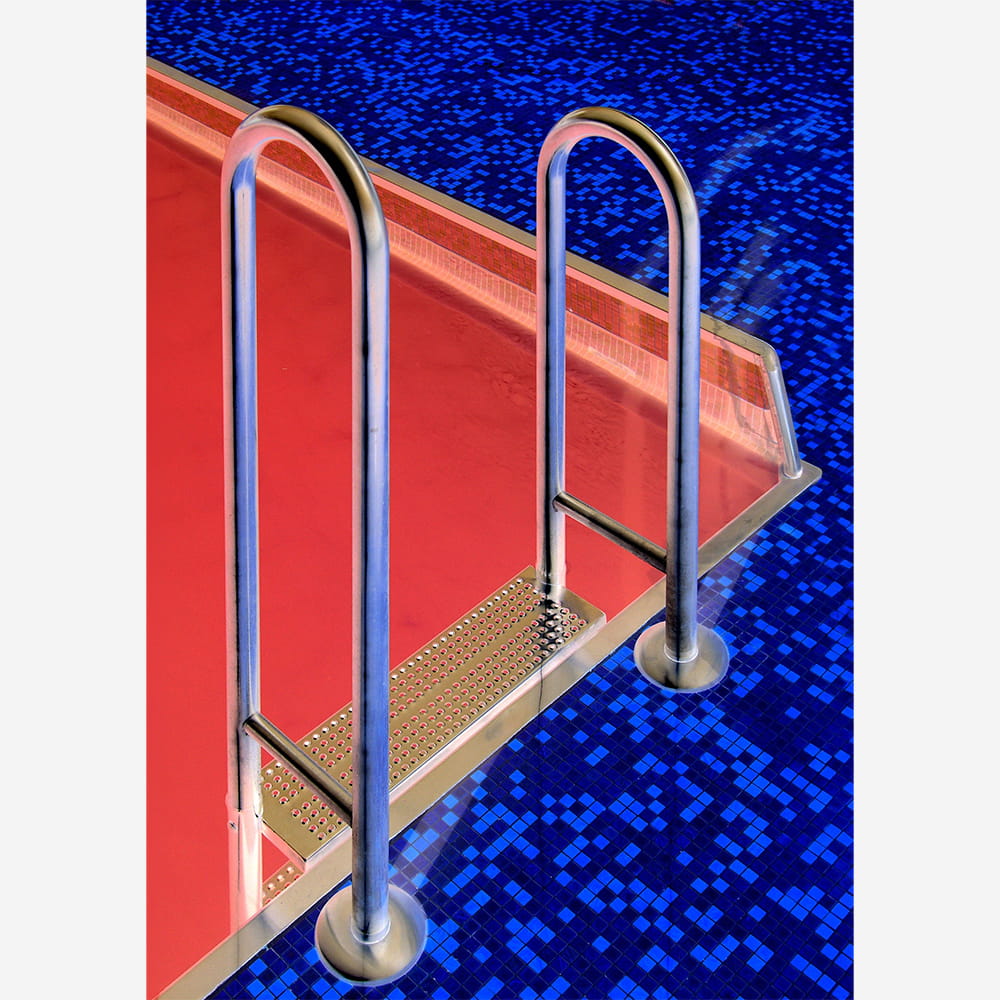
The mundane is a fickle thing; it only takes a slight shift in the spectrum to transform a symbol of leisure into a portal to the subconscious. What was once a standard cruise ship swimming pool – a predictable scene of chlorine and sunshine – has been stripped of its terrestrial context through the alchemy of digital inversion and reborn as a piece of surrealist architecture.
By inverting the colour palette, the image does more than just swap hues; it alters the emotional temperature of the environment. The primary blue of the tiled deck is replaced by an electric cobalt that feels more like a digital motherboard or a star-mapped sky than a wet walkway. However, the true shock to the system is the water. The familiar, inviting turquoise has flipped into a dense, viscous red. It no longer appears as a liquid meant for bathing; instead, it resembles a sea of mercury or a pool of liquid light, vibrating with an internal energy that defies the laws of physics.
The Geometry of the “Other World”
The transformation of the perpendiculars is where the “trick of the eye” takes hold. In its original state, the pool ladder provided a grounded sense of orientation – a clear transition from the solid deck to the buoyant water. In this inverted reality, those stainless steel rails have become glistening, alien spires. They rise from a floor that could easily be a ceiling, challenging the viewer’s vestibular system and sense of gravity.
- The Depth Paradox: Because the red “water” lacks transparency and reflects the rails with a metallic sheen, the sense of depth is annihilated. The viewer is left to wonder if the pool is three feet deep or an infinite, bottomless void.
- The Mosaic Texture: The blue tiles, now glowing with an unnatural intensity, create a “pixelated” effect. This suggests a simulated reality, making the scene feel less like a physical location and more like a high-definition glitch in a dream.
A Study in Surrealist Mystery
This work is a clear manifestation of a photographic interest in the surreal, specifically in how it handles negative space. In traditional photography, the eye looks for a recognisable subject; here, the subject is the void between the rails. The inversion forces a reconciliation with “the opposite,” presenting a photographic negative of a memory that feels haunted by its former self.
The mystery lies in the absolute silence of the frame. There are no ripples, no splashes, and no human presence. It is a still life of an impossible place. The post-processing serves as a bridge between the documentarian nature of a cruise ship snapshot and the limitless boundaries of digital art. It takes a moment designed for relaxation and turns it into a moment of cognitive dissonance.
This image stands as a testament to the power of the digital darkroom. It suggests that “other worlds” are not found in distant galaxies, but are hidden within mundane objects, waiting for a simple inversion of light to be revealed.