The Story Behind Architectural Echo
ARCHITECTURAL ECHO: in Tenerife, The Canary Islands
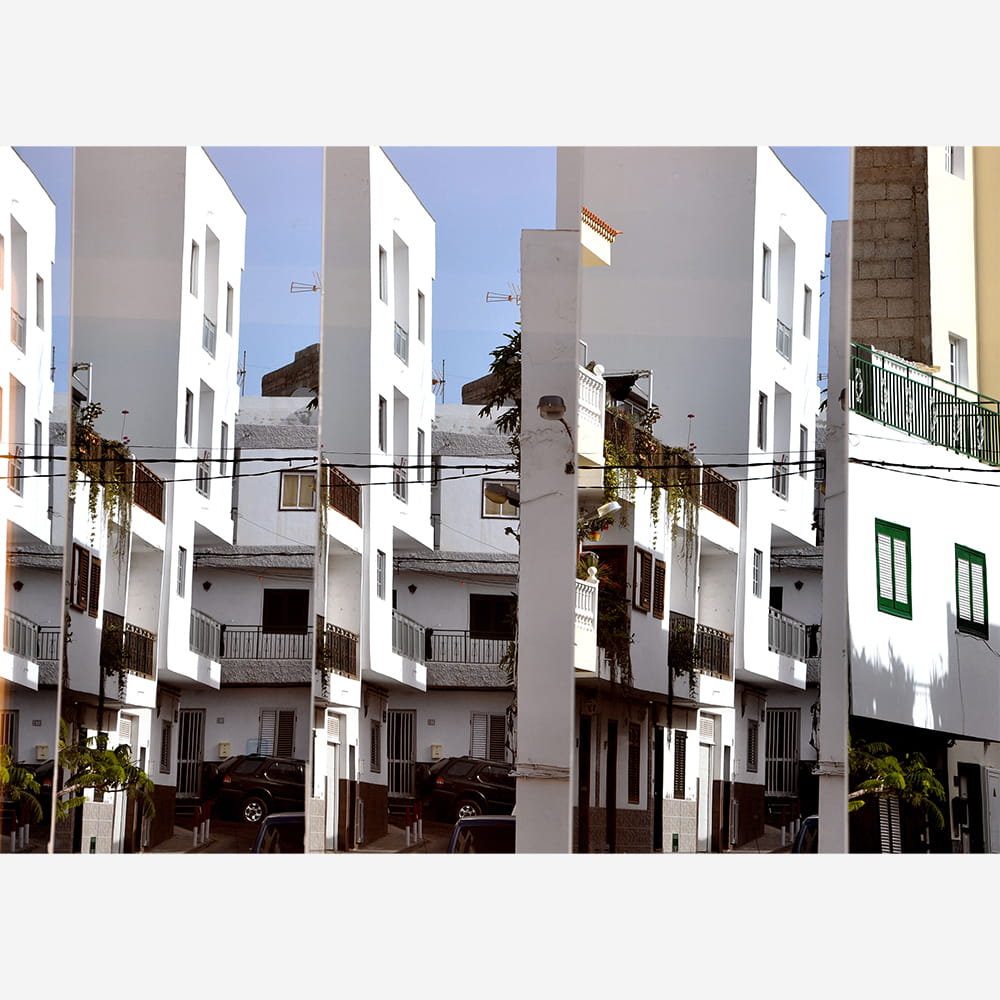
The street is narrow, a canyon of white stucco and dark asphalt where the sun plays a relentless game of geometry. On one side stands a residential block, unremarkable in its sturdiness, with its dark shutters and wrought-iron balconies trailing vines of green. On the other stands a modern interloper: a building cloaked in floor-to-ceiling glass, a wall of mirrors that has effectively hijacked the neighbourhood’s identity.
To walk past is to witness a visual echo. The house is no longer a single entity of stone and mortar; it has been shattered and reassembled across dozens of vertical panes. Each sheet of glass captures a slice of the architecture opposite, creating a rhythmic, disjointed parade of white facades. These reflections don’t merely show the house; they deconstruct it, pulling apart its balconies and windows into a surrealist colonnade that stretches toward the sky.
The effect is one of architectural vertigo. Because the glass panels are slightly angled or perhaps imperfectly aligned, the reflection doesn’t create a perfect twin. Instead, the house is continually repeated, a series of white towers that seem to loom taller and more slender than their physical counterparts. One pane catches the curve of a balcony, the next a shuttered window, and the third a stark white corner, creating a stuttering, cinematic loop of the same image. The house is trapped in a hall of mirrors, forced to look at itself from a thousand different, fractured perspectives.
In this glassy refraction, the mundane becomes monumental. The balconies, laden with hanging plants, are multiplied until they look like the hanging gardens of some futuristic city. The dark apertures of the windows become rhythmic beats in a visual symphony. Even the cars parked at the base of the original building are swept into the illusion, their dark curves appearing and disappearing in the lower reaches of the glass, anchoring the ethereal reflections to the solid ground.
There is a strange, quiet tension in this relationship. The original house sits silent and heavy, bearing the weight of its years and the salt-tinged air. Its reflection, however, is weightless, flickering with the movement of every passing cloud and the shift of the afternoon sun. The glass building acts as a silent archivist, recording every detail of its neighbour but stripping away its solidity.
As the sun moves across the zenith, the reflections shift. The white of the stucco flares into a blinding brilliance, then cools into a soft, bluish grey as shadows begin to crawl across the street. For a moment, it is hard to tell where the physical world ends and the glass world begins. The house exists in two places at once: once in the reality of the street, and a dozen times more in the shimmering, vertical dreamscape of the adjacent building. A ghost of architecture, haunting the very glass that tries to contain it.