The Story Behind Postcards from Paris: A Symphony of Steel and Leaves
Beneath the Iron Lattice: A Shift in Perspective
The Eiffel Tower is almost universally consumed as a distant silhouette—a postcard backdrop framing romantic Parisian strolls, postcard horizons, and sweeping cityscapes. Viewed from across the Champ de Mars or atop the Trocadéro, its profile is familiar, static, and symbolic. Yet to step directly beneath its wrought-iron feet and look upward is to dismantle that postcard entirely, trading a passive icon for a living, breathing monument of industrial ambition.
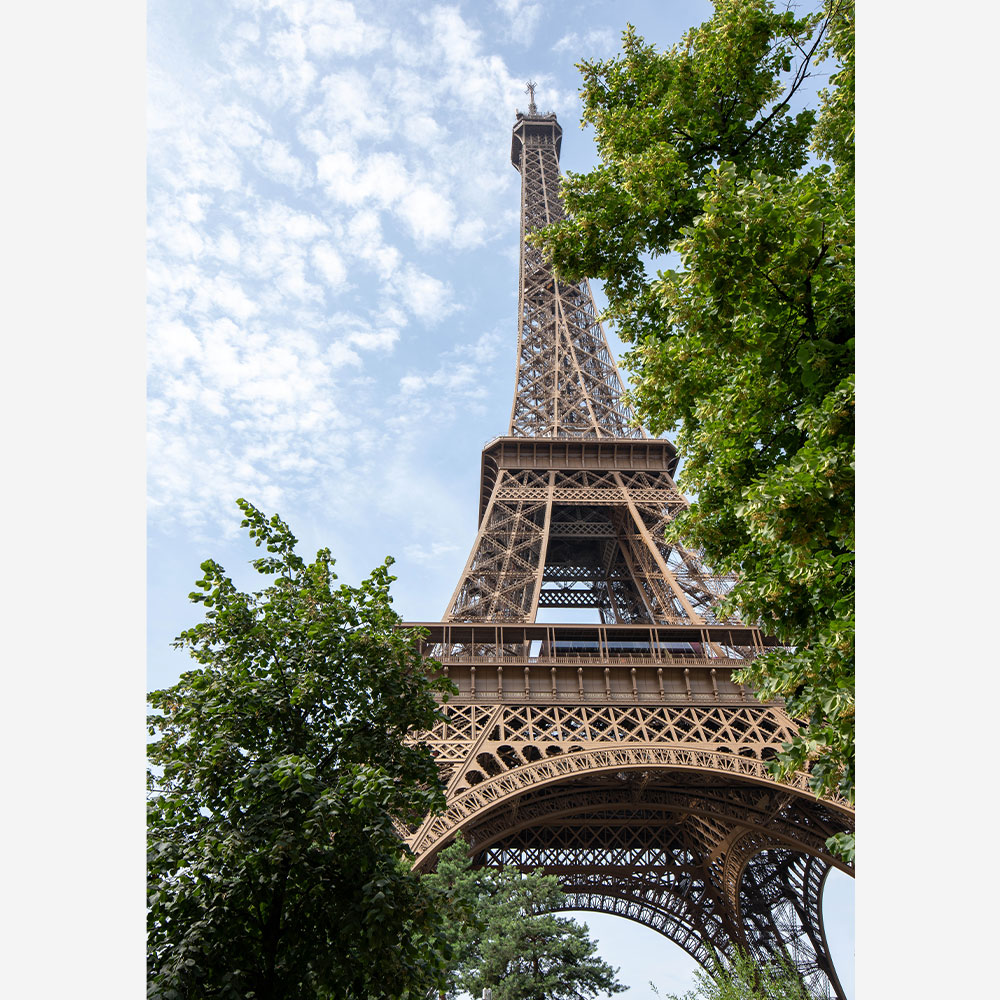
From a low, upward angle, the tower abandons its delicate, needle-like proportion. The soaring arches at the base loom with massive structural gravity, transforming into immense doorways carved directly into the sky. The intricate ironwork, which appears almost like lace from a mile away, suddenly reveals itself as heavy, deliberate engineering: thousands of intersecting beams, rigid diagonal bracing, and meticulous riveting. Framed by leafy green canopies, the dark brown metal contrasts sharply with the soft blue sky and scattered white clouds. The structure does not simply stand in Paris; it reaches through the foliage, anchoring the earth to the atmosphere.
This literal shift in perspective mirrors an essential intellectual shift. In standard historical narratives, Gustave Eiffel’s creation is often framed merely as an artistic triumph or a testament to French elegance. Yet its birth in 1889 for the Exposition Universelle was met with intense public disdain, viewed by prominent artists of the era as a hideous, industrial blot on classic architecture. Examining the monument from the ground up recasts it not as a decorative ornament, but as an unapologetic triumph of modern structural physics. It was designed to withstand extreme wind dynamics rather than satisfy traditional aesthetic conventions, proving that utility and geometry could forge a brand-new definition of beauty.
Looking upward, one sees how the tower mediates between nature and human construction. The surrounding trees do not merely surround the iron giant; they act as living anchors, soft organic borders against the sharp, geometric precision of the iron lattice. As wind rustles through the leaves, it whispers against a structure built specifically to bend without breaking under atmospheric pressure.
To experience the Eiffel Tower from below is to remember that icons are not born as static symbols. They are built piece by piece, rivet by rivet, from human sweat and bold calculations. Shifting both our physical gaze and our literary lens reveals the monument’s true nature: an extraordinary convergence of iron, sky, and human vision.